There was a time when planning a holiday usually began with a place.
Paris. Barcelona. Nashville. Tokyo. Amsterdam.
You chose the destination first and then worked out what you might do once you arrived.
Live music is quietly reversing that process.
For a growing number of travelers, the first question is no longer simply where should I go? It is who I want to see, and where they’re playing.
A concert announcement, festival line-up or one-night-only performance can suddenly put a city on the map. Someone who had never seriously considered traveling to Manchester may start comparing hotels because a favorite band is playing there. A festival outside Lisbon becomes the reason to spend a week exploring Portugal. A Las Vegas residency turns into a long weekend of restaurants, neighborhoods and desert landscapes.
The event starts the journey.
Everything else grows around it.
And that shift is changing not only how people discover destinations, but also what they expect from travel once they arrive.
A ticket can be the beginning of a much bigger trip
Buying a concert ticket used to feel like the end of the decision.
You knew where you were going and what you were doing.
Now it is often only the beginning.
Once the ticket confirmation arrives, a different set of questions follows.
Where should we stay? How close is the venue to the parts of the city we actually want to explore? Should we arrive a day early? What is worth doing before the show? Is there somewhere interesting to go afterward? Could this become a three- or four-day trip instead of an overnight stay?
This is what makes event-led travel interesting.
The performance may last two hours, but the memories surrounding it can stretch across an entire journey.
Think about arriving in a new city the afternoon before a show. There is the first walk through an unfamiliar neighborhood, dinner somewhere you found almost accidentally, the gradual appearance of people wearing tour shirts, the queues outside the venue and the shared anticipation of thousands of strangers heading in the same direction.
The following morning, the music is over, but the trip is not.
There is still coffee to find, a museum you had not expected to visit, a neighborhood someone recommended the night before, perhaps even another city a short train ride away.
The concert provided the reason to go.
Travel gave the event a setting.
Music can introduce us to places we might otherwise overlook
Some destinations rarely need help attracting visitors.
People will continue traveling to London, New York, Paris and Rome regardless of who is appearing on stage that weekend.
Live events become particularly interesting when they draw people somewhere they might not otherwise have considered.
A tour can send fans beyond the obvious capitals. Festivals often take place in smaller cities, coastal towns, countryside settings or former industrial areas. Venues themselves can lead travelers into neighborhoods well outside the conventional tourist center.
Suddenly, choosing between tour dates becomes a form of travel planning.
Do you see the artist somewhere familiar, or use the opportunity to discover a completely different place?
For an adventurous traveler, the second option can be difficult to resist.
This is especially true in Europe, where relatively short rail journeys can turn one concert into a broader itinerary. A show in Amsterdam might sit between a few days in Belgium and Germany. Barcelona can become the beginning of a journey along the Spanish coast. A performance in Milan might provide the excuse to continue towards the lakes or spend several days elsewhere in northern Italy.
Music has become an unexpected route planner.
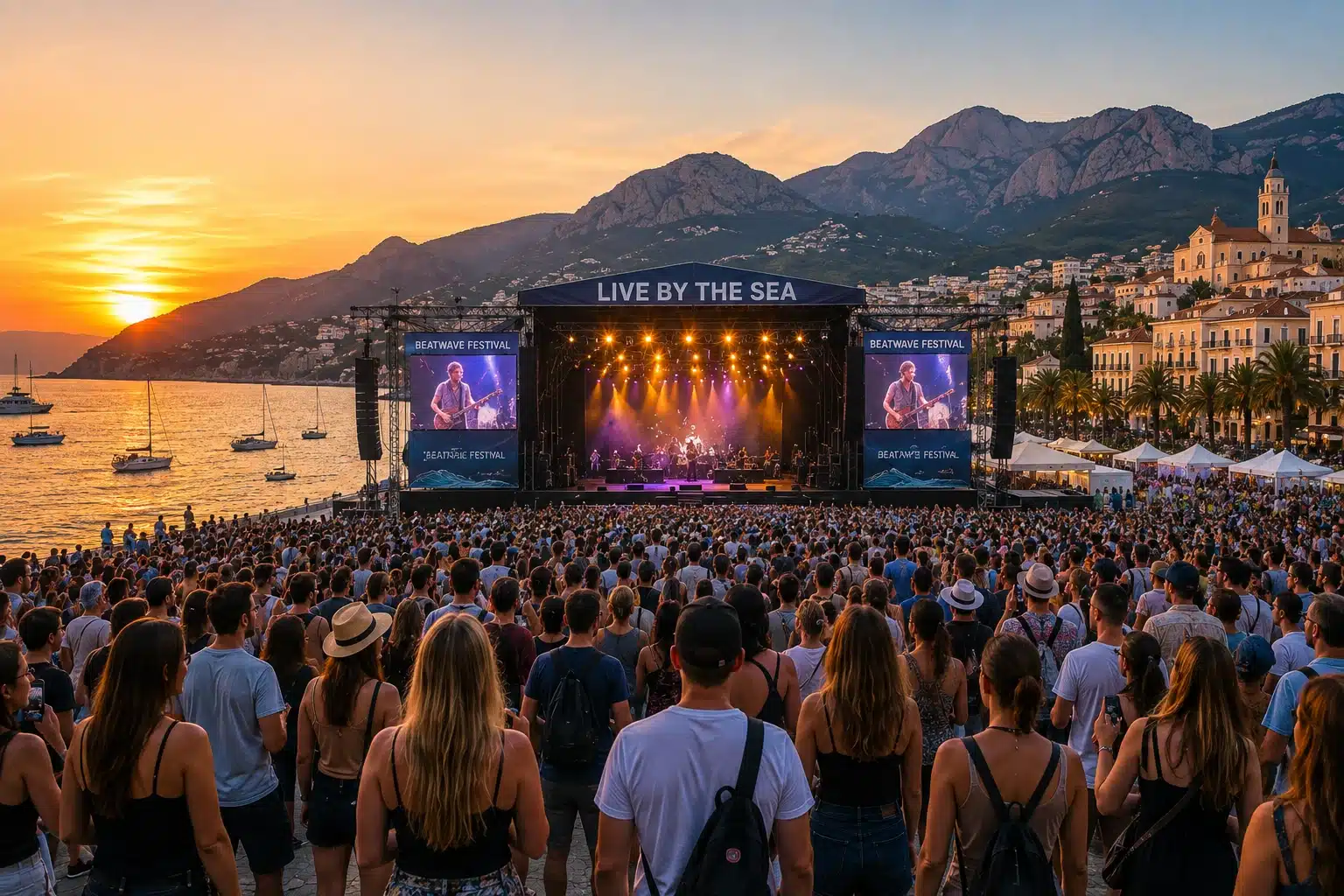
Festivals make the destination part of the performance
Festivals take the relationship between music and place even further.
The setting is rarely incidental.
A festival beside the sea feels different from one surrounded by mountains. A city festival changes depending on whether you step outside into medieval streets, skyscrapers, canals or beach promenades.
Even festivals with similar line-ups can create completely different travel experiences because of where they happen.
That is one reason successful festival trips are often remembered as more than a collection of performances.
People remember the campsite at sunrise.
They remember the local restaurant they discovered after leaving the festival grounds.
They remember traveling there with friends, getting slightly lost, learning the transport system and finding the one café everyone returned to each morning.
The music anchors the memory, but the destination fills in the rest.
PureTravel has long highlighted how events can reveal something deeper about a location, whether that is music in Rotterdam, theatre in Avignon, or a cultural festival in Japan. The best event-led journeys work because the occasion doesn’t sit separately from the destination. It gives travelers another way to experience it.
Discovery is becoming part of travel planning
Another reason event-led travel feels different today is that how people discover events has changed.
A traveler may first hear an artist through a streaming recommendation. A concert clip appears on social media. A friend shares a festival line-up. An artist announces a tour.
Within minutes, music discovery can become destination discovery.
The difficult part comes afterward.
Event information often lives in one place. Accommodation lives somewhere else. Destination inspiration is somewhere else again. Experiences, neighborhood guides, and travel ideas require another round of searching.
That fragmentation explains why event discovery and travel planning are moving closer together.
Platforms such as VewTopia reflect this event-first approach by connecting concerts and festivals with the destinations, stays and experiences surrounding the trip.
The important idea is not simply making it easier to buy a ticket.
It is recognizing that the person buying that ticket may also be choosing their next destination.
For travelers who increasingly think in terms of experiences rather than traditional holidays, that difference matters.
The best concert trip leaves room around the concert
When traveling for a major event, there’s a temptation to plan every minute.
Flight. Hotel. Dinner reservation. Venue. Breakfast. Museum. Train.
It makes sense. The ticket may have been expensive, the destination unfamiliar, and the trip relatively short.
But some of the best event-led journeys leave a little space.
If the concert is Saturday evening, arriving Friday instead of Saturday afternoon changes the rhythm immediately. You are no longer racing the clock. There is time to understand the neighborhood and perhaps see something that has nothing whatsoever to do with music.
The same is true afterward.
Leaving at dawn the morning after a festival might save a night’s accommodation, but it can also mean missing the destination entirely.
Whenever possible, build at least one piece of the itinerary that exists independently of the event.
It could be a food market.
A coastal walk.
A local museum.
A neighborhood far from the venue.
A train journey into the surrounding countryside.
The goal is simple: if someone removed the concert from the itinerary, the trip should still have something worth remembering.
That is when event travel becomes real travel.
Where you stay can change the whole experience
Location matters more than it seems at first.
The hotel closest to the venue is not automatically the best choice.
Staying beside an arena might simplify the journey home after the performance, but it could leave you isolated from everything you want to do during the rest of the weekend.
Before booking accommodation, look at the destination as a whole.
Where is the venue?
Where are the neighborhoods you want to explore?
How does public transport operate after the event?
Will thousands of people be trying to use the same station?
Could you comfortably walk back?
For festivals outside city centers, transport deserves even more attention. Shuttle schedules, last trains and taxi availability can determine whether accommodation that looks convenient on a map actually is.
A little research here can make the difference between ending an extraordinary night with an easy walk through the city and spending two frustrating hours trying to get back to your hotel.
The crowd changes the destination too
Something unusual happens when thousands of people arrive somewhere for the same reason.
For a few days, the event temporarily becomes part of the city’s identity.
You notice it at railway stations and airports.
You hear conversations about it in cafés.
Bars change their playlists. Restaurants fill earlier or later than usual. Hotels become unofficial meeting points. People who have never met recognize one another by a T-shirt or wristband.
This temporary community is one of the pleasures of traveling for live entertainment.
At home, enjoying an artist can be a private experience.
At a destination event, it becomes social.
You share the city with people who have crossed countries, states, or oceans for exactly the same reason.
That atmosphere is hard to reproduce anywhere else.
Event-led travel can also make choosing easier
The modern traveler has almost unlimited choice.
Hundreds of destinations look attractive.
Thousands of hotels are available.
You can research entire continents on a phone.
Choice should make travel easier, but sometimes it does the opposite.
Where do you begin?
An event provides an answer.
You are going to Chicago because the band is there.
You are traveling to Belgium because the festival is there.
You are spending a weekend in Madrid because the tour date works.
The decision has already been made.
Instead of comparing twenty possible destinations, you can concentrate on making one destination more interesting.
There is something wonderfully freeing about that.
A new way to collect places
Most travelers have some version of a list.
Countries they want to visit.
Cities they have always imagined seeing.
Beaches, mountains, restaurants, or historic places they hope to experience one day.
Live events create a different kind of list.
Places you visited because somebody took a stage there.
The city where you finally saw the artist you had followed for ten years.
The town you knew nothing about until a festival appeared on the calendar.
The neighborhood you discovered because the venue happened to be there.
Years later, it can become difficult to separate the music from the geography.
A song brings back a station platform.
An album reminds you of a hotel room.
A festival poster recalls the smell of a particular street after rain.
That is the remarkable thing about traveling for music.
The event may be temporary.
The relationship with the place does not have to be.
Sometimes the best answer to “where next?” is already on the calendar
Travel will always begin in different ways.
Sometimes we chase sunshine.
Sometimes food.
Sometimes history, wildlife, landscapes or the simple desire to be somewhere unfamiliar.
And sometimes it starts when an artist announces a date in a city we had never planned to visit.
That is not a lesser form of travel.
It can be one of the most rewarding.
A concert gives the journey purpose. A festival provides a deadline. A venue gives us a point on the map.
Then curiosity does the rest.
Perhaps that is the real appeal of event-led travel.
We may leave home because of what is happening on the stage.
But very often, we return remembering everything that happened around it.
We may leave home because of what is happening on the stage.
But very often, we return remembering everything that happened around it.