Madrid doesn’t shout. It hums.
The city reveals itself slowly. A side street near La Latina with a tapas bar that’s been open since 1870. A rooftop terrace overlooking the Royal Palace at golden hour. The sudden silence of the Retiro Park lake on a Tuesday morning. Most visitors experience Madrid from the back of a taxi or the window of a metro car, and that works perfectly well.
But there is a version of Madrid, and of the region around it, that only opens up when you’re the one driving.
The Case for Driving in Madrid
Let’s be honest: you don’t need a car to explore the city centre. The metro is excellent, taxis are cheap, and walking is half the fun. But Madrid sits at the geographic centre of Spain, surrounded by some of the country’s most underrated destinations, and those require wheels.
The Sierra de Guadarrama is 45 minutes north. Toledo, the ancient capital, is an hour south. Segovia with its Roman aqueduct is 90 minutes northwest. Chinchón, a medieval village with one of Spain’s most photogenic plazas, is barely 50 kilometres away. These day trips transform a city break into something far more memorable. And the roads between them? Winding mountain passes, open plains, and stretches where you won’t see another car for minutes.
For most visitors, a standard rental covers the basics. But if this trip is more than basic, perhaps a milestone birthday, an anniversary, or a trip you’ve been planning for years, it’s worth making the drive part of the experience. The luxury car rental Madrid market has grown fast in recent years. Providers deliver Ferraris and Porsches to your hotel door with full insurance, and the mountain roads around the city are exactly what these cars were built for.
Three Drives Worth Planning Your Day Around
1. Madrid to Toledo via the CM-42
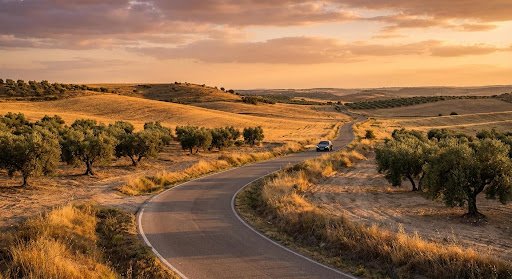
Skip the A-42 motorway. The CM-42 takes you through rolling countryside dotted with olive groves and small villages. Toledo appears on a hilltop like something from a painting, because it literally was. El Greco painted this view in the 1600s. Park outside the old walls, walk in, and spend half a day getting lost in the narrow streets. Budget three hours for the round trip, plus as long as you want in the city itself.
Head north on the M-607 toward the Sierra de Guadarrama national park. The road climbs through pine forests to the Navacerrada pass at 1,858 metres. On a clear day, you can see the Madrid skyline behind you and the Castilian plateau stretching north. The switchbacks are well-maintained and the gradient is serious enough to make a good car feel like a good decision. Come down via Cercedilla for coffee before heading back.
3. Chinchón and the Aranjuez Wine Country
South of Madrid, the landscape flattens into vineyards and agricultural plains. Chinchón’s Plaza Mayor is a medieval oval surrounded by wooden balconies. It’s been used as a bullring, a theatre, and a market since the 15th century. From there, continue to the Royal Palace of Aranjuez, a Bourbon summer residence with gardens that rival Versailles. The whole loop is under 150 kilometres.
Practical Tips for Driving in Madrid
Parking in the centre is not fun. Madrid’s low-emission zone (Madrid 360) restricts older vehicles in the city centre. If your car is a recent model, you’re fine, but street parking is scarce. Use one of the many underground car parks. Plaza de España and Retiro have reliable options.
Toll roads are optional but faster. The radial toll highways (R-2, R-3, R-4, R-5) run parallel to the free autovías and are almost always empty. If you value time over a few euros, they’re worth it.
Fuel is cheaper outside the city. Fill up at stations on the outskirts rather than in the centre.
Rent for the days you’ll actually drive. If you’re spending three days walking the city and one day driving to Toledo, you don’t need a car for the full trip. Most rental services offer single-day or weekend options.
When to Go
Spring (April to June) and autumn (September to November) are ideal. Summer in Madrid can hit 40°C, which makes a convertible either the best or worst idea depending on your heat tolerance. Winter is mild by northern European standards and the Sierra gets snow. The mountain roads are stunning when they’re white.
The Bottom Line
Madrid works perfectly well without a car. But the region around it, the mountains, the medieval towns, the vineyard country, is where the real stories happen. A good car and a free afternoon can turn a three-day city break into something you talk about for years. That’s not a tourism cliché. It’s geography. Madrid is surrounded by greatness. You just need to drive to it.
Image: Nero-line.com