
“Two hands on a wing, and suddenly — you are flying.”
There are moments in the history of any sport when something genuinely new arrives — not an evolution of what came before, but a true disruption. Wingfoiling is one of those moments. Born from the crossroads of windsurfing, kitesurfing, and foil technology, wingfoil has in just a few short years grown from a curious experiment into one of the most talked-about water sports on the planet. And once you understand what it feels like to silently lift above the surface of the water, powered by nothing but wind and your own sense of balance, it is very easy to understand why.
What is wing foiling and how does it work?
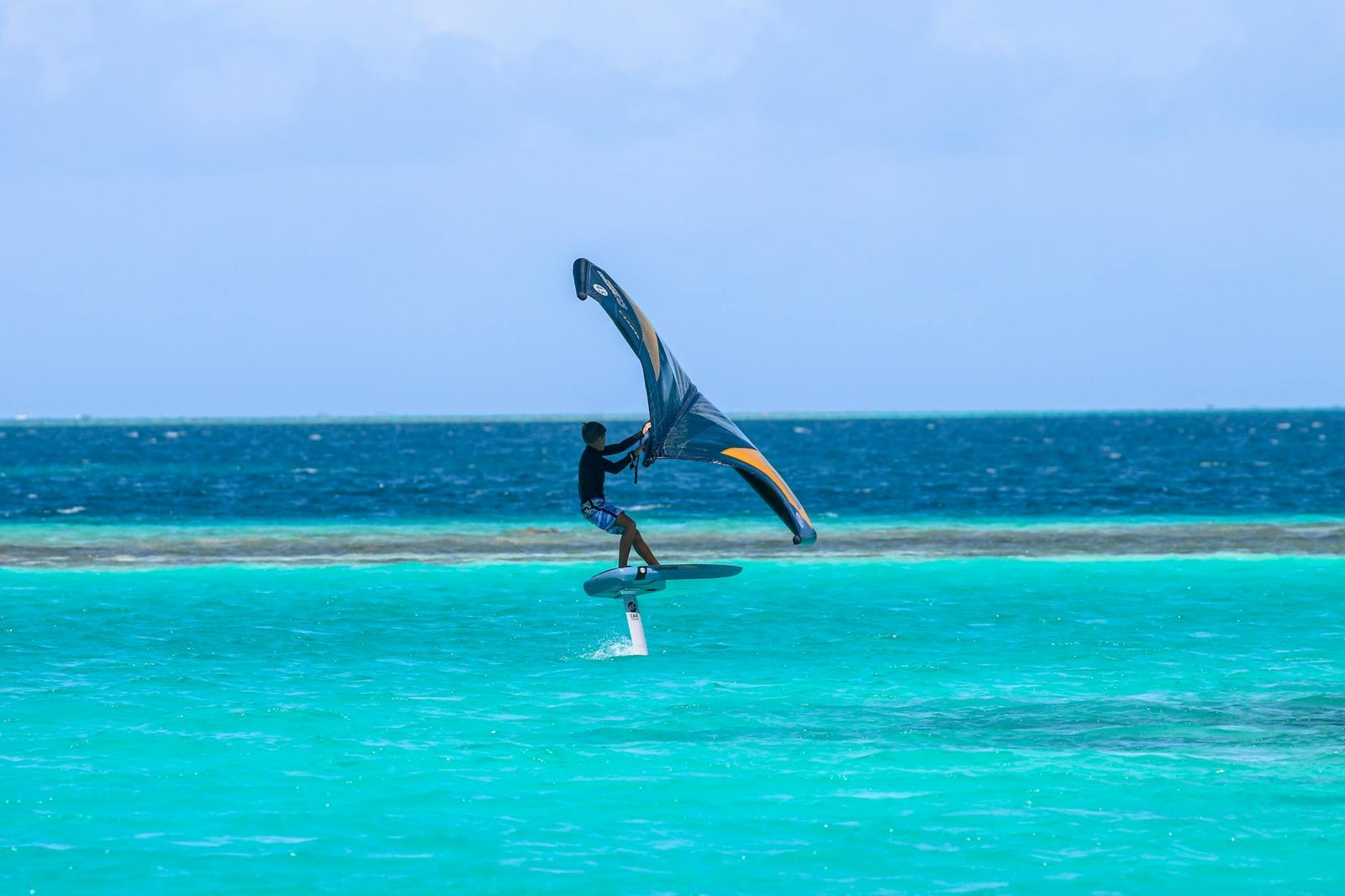
Wing foiling combines three elements that, taken separately, most water sports enthusiasts will already know: a hydrofoil board, a foil mast and wing assembly mounted beneath the board, and a handheld inflatable wing. The rider stands on the board, holds the wing above them to catch the wind, and as speed builds, the foil lifts the board — and the rider — completely clear of the water. What follows is a sensation that veterans of other water sports consistently describe as unlike anything they have experienced before: near-silent flight, minimal spray, extraordinary speed, and a direct, intuitive connection between body and wind.
Unlike windsurfing, there is no boom or mast attached to the board — the wing is entirely handheld and can be released instantly, making it feel more approachable for beginners in terms of safety. Unlike kitesurfing, there are no long lines connecting rider to power source, which removes much of the setup complexity and the spatial awareness required to fly a kite safely. Wing foiling occupies a uniquely accessible middle ground — genuinely learnable for motivated beginners, yet with a performance ceiling high enough to captivate the most experienced water sports athletes for years.
Why wing foiling is growing so fast
The growth of wing foiling has been remarkable by any measure. Schools that introduced it as an experimental addition to their curriculum just a few seasons ago now report it as their most requested discipline. Equipment manufacturers who initially hedged their bets are now dedicating entire product divisions to wing foil development. Competitions, festivals, and dedicated wing foil travel camps are appearing on every major wind destination in the world.
Several factors explain this acceleration. First, the equipment has matured at extraordinary speed. Early wings were experimental and inconsistent — today’s wings from leading brands are refined, reliable, and available in a wide range of sizes to suit different wind conditions and rider weights. Foil systems have become more modular and beginner-friendly, with front wings designed specifically to provide slow-speed stability during the learning phase before rewarding progression with genuine high-performance capabilities.
Second, wing foiling is genuinely exciting to watch. Video content of wing foilers skimming above turquoise water, carving effortless gybes, or launching into jumps has spread across social media with remarkable reach, inspiring a new generation of water sports enthusiasts who might never have considered windsurfing or kitesurfing. The visual drama of a rider lifting silently above the surface is immediately compelling — and it translates directly into curiosity and ambition.
Third, the community around wing foiling is young, welcoming, and enthusiastic. Because the sport is new, there is no established hierarchy of experience to navigate. Beginners and experts share the same lineups, swap tips freely, and share a collective sense of being part of something at the beginning of its story.
Learning to wing foil: what to expect
Wing foiling has a reputation for being learnable — and that reputation is largely deserved, provided the approach is right. Like any foil-based discipline, the process breaks down into distinct phases that build on each other logically.
Most beginners start on a large, stable foil board in flat or very light chop water, learning first to control the wing on land, then from a kneeling position on the water, then standing without foiling, and finally — when balance and wing control are solid — allowing the foil to lift and fly. Many riders reach their first sustained foiling runs within two to four days of focused instruction, though individual progression varies enormously depending on prior board sports experience and physical conditioning.
Having good instruction matters significantly. A qualified wing foil instructor not only accelerates progression but also teaches safe practices around equipment handling, right of way, and self-rescue — all important considerations in a sport where the rider is physically separated from the board by a foil mast in the event of a fall. Most established kite and windsurf schools now offer wing foil lessons, and dedicated wing foil camps in locations with consistent wind are an increasingly popular way to fast-track the learning process.
The learning curve, while real, is one of the most rewarding journeys in water sports. Every session brings visible progress, and the moment the foil first lifts cleanly and holds — that first true flight — is something riders remember for the rest of their lives.
Choosing your wing foil equipment
Selecting the right setup as a beginner is one of the most important decisions in the wing foil journey, and it is worth taking seriously. The wrong combination of board volume, foil size, and wing area can make early sessions unnecessarily frustrating — while the right combination makes progress feel almost effortless.
For beginners, a high-volume board — typically between 100 and 150 litres depending on the rider’s weight — provides the flotation and stability needed to learn wing control and board balance without fighting the equipment. A large front wing with a high aspect ratio designed for low-speed lift allows the foil to become airborne at gentler speeds, giving the learner more time to find their balance before the board accelerates. A mid-size wing in the five to six square metre range suits most beginner-to-intermediate riders in moderate wind conditions.
As skills develop, riders typically progress to lower volume boards, higher aspect foil wings for greater efficiency and speed, and a wider range of wing sizes to cover different wind strengths. The modular nature of modern wing foil systems — where masts, fuselages, front wings, and rear stabilizers can be mixed and matched — means a well-chosen initial foil system can evolve with the rider for several seasons rather than requiring a complete replacement as skills improve.
Wetsuits, impact vests, helmets, and buoyancy aids round out the safety equipment picture — and while wing foiling is not uniquely dangerous among water sports, wearing appropriate protection during the learning phase is strongly recommended.
Everything you need for wing foiling — at EASY-surfshop
Whether you are stepping onto a foil board for the very first time or looking to upgrade to a high-performance setup that matches your developing skills, EASY-surfshop has everything you need in one place. The full wing foil range — boards, foils, wings, masts, impact vests, wetsuits, leashes, and all supporting accessories — is available from a team of specialists who ride the gear themselves and understand what works at every stage of progression.
As experts across windsurfing, kitesurfing, SUP, and wing foiling, EASY-surfshop brings a depth of cross-disciplinary knowledge that generic sporting goods retailers simply cannot match. If you are not sure where to start, the team is on hand to help you build the right setup for your weight, local conditions, budget, and ambitions.
The wind is out there. The foil is waiting. All that is missing is you.
Shop the full wing foil range at: https://easy-surfshop.com/en/wing-foil
Image: Pexels, Fuka Jaz