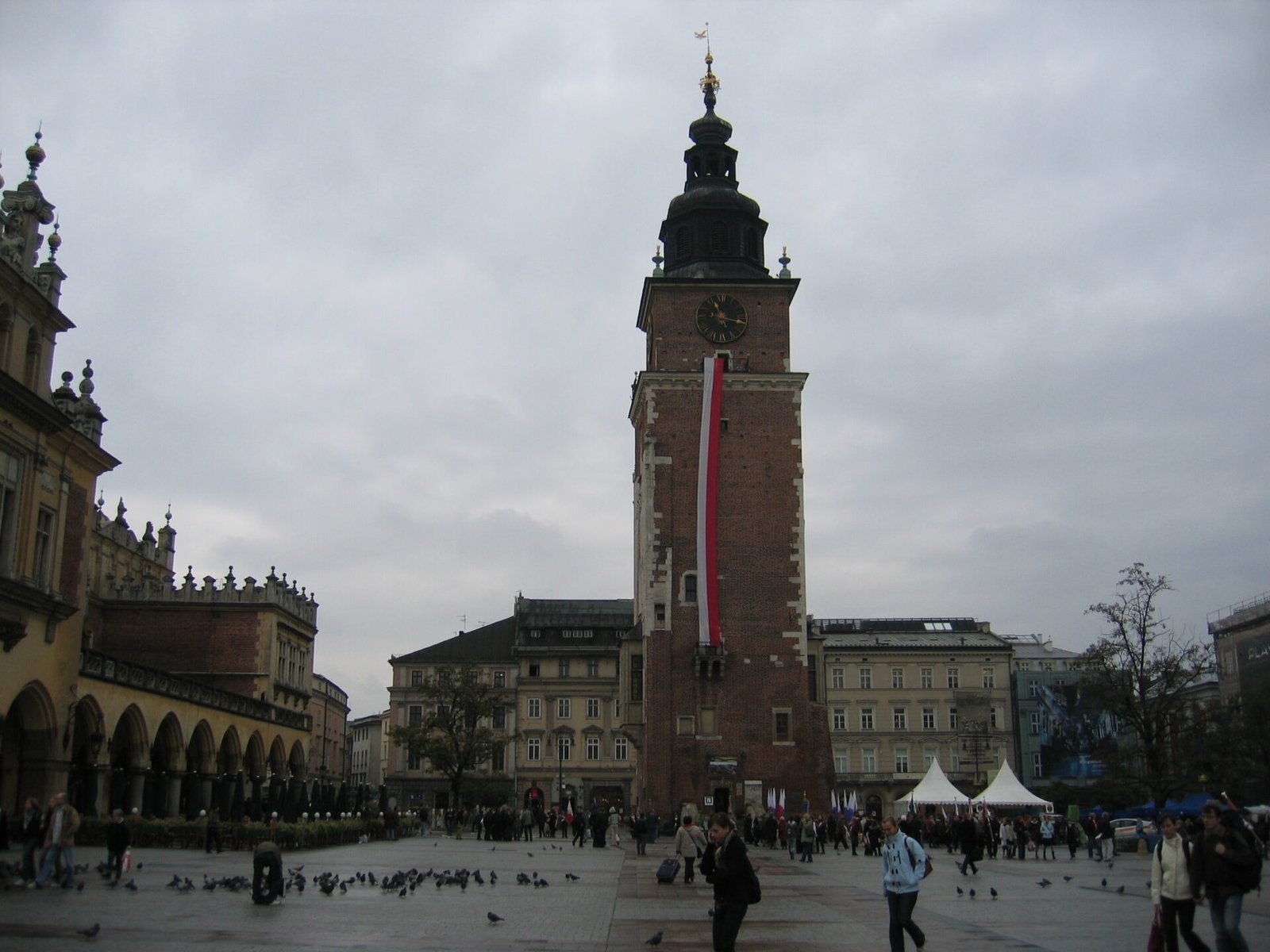
The firemen of Kraków have an unusual responsibility. Alongside their day jobs, they are custodians of a ritual that has echoed across the city for more than six centuries. Every hour, on the hour, a lone bugler climbs 239 uneven stone steps to the top of a Gothic tower and sends a five-note melody drifting across the Old Town rooftops.
It never finishes.
Mid-phrase, the tune stops abruptly. Legend has it that in 1241, as Tatar forces advanced on the city, a watchman sounded the alarm, only to be struck through the throat by an arrow before he could complete the call. Since then, the music has always broken off, suspended in the air.
The ritual continues today, unchanged, played day and night by members of the city’s fire brigade from the tower of St. Mary’s Basilica, just as it has for centuries.
Earthquakes, wars and occupations have failed to silence it.
The pressure is considerable: the climb alone takes just two and a half minutes. Then there’s the small matter of history.
I hear it standing in Rynek Główny, Europe’s largest medieval market square. Pigeons crowd the arcades and gargoyles, coffee steam drifts into the winter air, and Renaissance facades sit comfortably beside Gothic towers. Narrow alleyways peel away from the square, leading visitors astray. Kraków feels intact in a way much of Central Europe does not.

That matters. During the Second World War, Poland was devastated. Warsaw alone lost around eighty per cent of its buildings. Kraków survived largely unscathed, though its scars remain, quietly embedded in backstreets and memory. Nowhere is this more palpable than in Kazimierz, the old Jewish quarter. Once emptied and neglected, it has been slowly restored since the 1990s. Cafés, bars and music spill onto the streets, giving the area a bohemian hum, yet the spaces between still feel heavy with absence.
The city’s contrasts are constant. The calm authority of Wawel Castle, home to Polish kings for five centuries, rises above the Vistula, its Sigismund Bell, eleven tonnes of bronze, reached by a surprisingly modest wooden staircase. Elsewhere, nightlife pulses behind anonymous doors: vaulted cellars, vodka poured without ceremony.
That energy feels sharply different after a visit to Auschwitz-Birkenau Memorial and Museum.

We visited in late October, in bitter cold. Mist hung low over the infamous Arbeit macht frei sign, softening its outline. A line from Timothy Findley’s The Wars, written about the First World War, kept returning to me: “Look! You can see our breath.” Here, it felt uncomfortably literal. Proof of life, in a place defined by its systematic removal.
Inside the blocks, silence presses in. Hair, shoes, suitcases, spectacles: the reality is unbearable. People move slowly, instinctively quieter. Outside, dark shadows break pools of light. Everywhere, hunched silhouettes stand with hands shoved deep into pockets.
At the Death Wall, a family huddled together, sobbing. The woman at its centre was a survivor, the guide tells us, returning with her children and grandchildren. No one approached. The moment belonged entirely to them.
Nothing prepares you for the scale. A visit here strips away abstraction and replaces what you think you understand with something far heavier, harder to carry. No book, however powerful, can fully convey the brutality of the place.
The return journey to Kraków was subdued. Conversation ebbed away as darkness crept across the bus windows, each of us trying to order our thoughts. The city lights finally appeared, glowing warmly against the cold – embers of hope and progress. Then and now.
Encircling the Old Town, the green ring of Planty Park offers space to walk, to recalibrate. It is easy to spend time here drifting in and out of history.
When the bugle sounds again over Rynek Główny, its unfinished melody feels less like an interruption and more like a reminder. Some stories are not meant to resolve. They are meant to be heard, remembered, and carried forward.
We are still listening.