There are places best understood from the water. The Amalfi Coast belongs to that precise category of landscapes where the point of access radically changes perception. From land, the sequence of curves, terraces, and suspended villages inspires admiration. From the sea, the experience gains a different density: cliffs rise without mediation, façades align like layers of a vertical history, and the Mediterranean ceases to be a backdrop and becomes the main character. Sailing along this stretch of the Tyrrhenian Sea is not about getting from one point to another, but about embracing a different form of experiential tourism, slower, more attentive, less inclined to settle meanings too quickly.
The coastline seen from another height
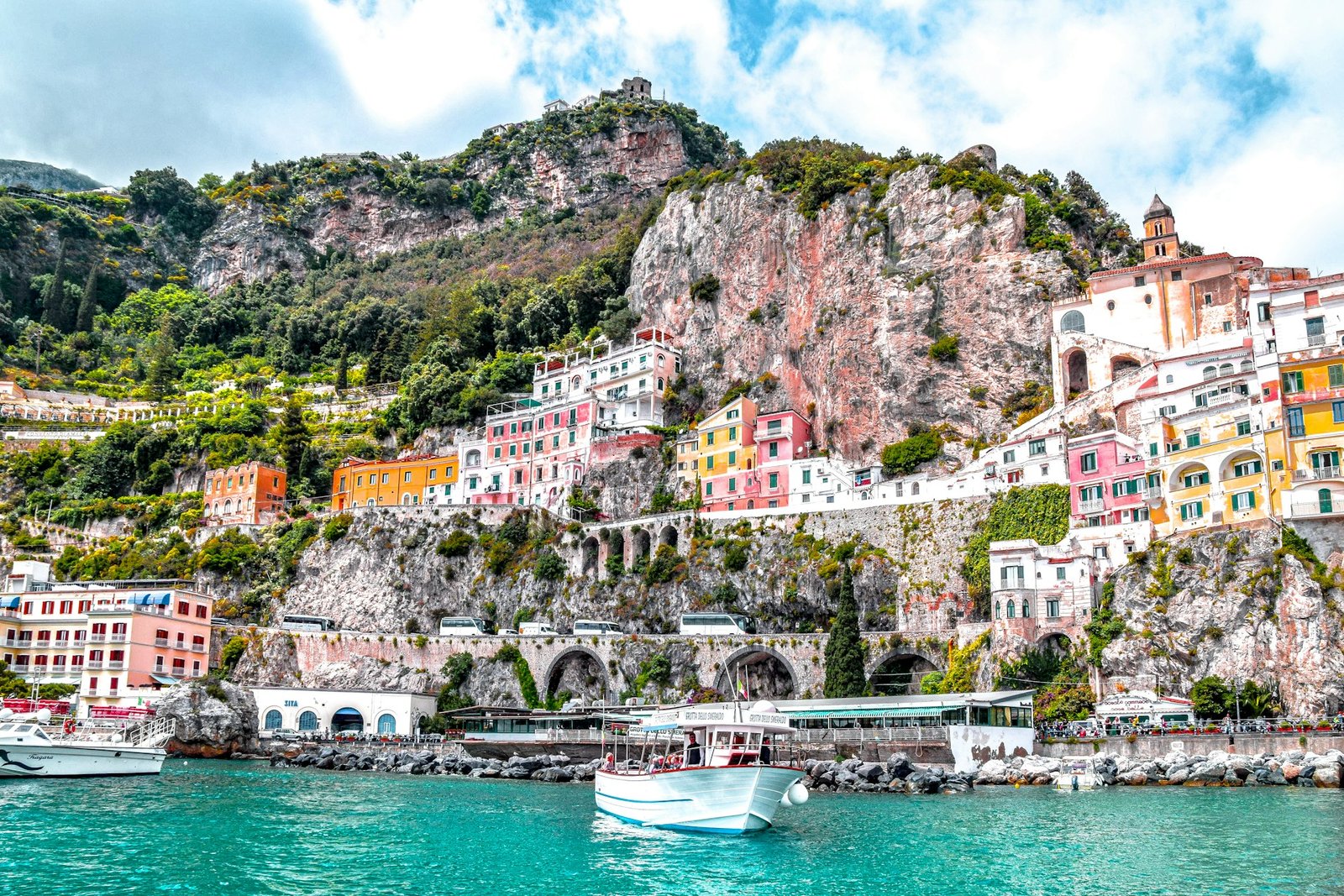
Coastal navigation reveals a geography that appears fragmented from the road. Villages emerge one after another, connected by the sea for centuries. Amalfi appears compact, its cathedral dominating the urban fabric; Positano cascades downward, as if shaped by gravity itself; Praiano hides within folds of rock that only become evident from the water. The profile of the Amalfi Coast gains a continuity that leaves no room for shortcuts.
On deck, time organizes itself differently. Rhythm is dictated by light, wind direction, and the shifting color of the water. The coast is not crossed, it is accompanied. And this prolonged companionship transforms the relationship with the landscape, which ceases to be decorative and becomes an active environment.
Suspended villages and maritime memory
Before becoming tourist icons, these towns were ports, trading points, nodes in an economy that looked more toward the sea than inland. Amalfi, a former maritime republic, preserves this identity in its layout and in its direct relationship with the water. From the boat, the city feels less like a destination and more like the natural outcome of centuries of passage.
Further along, Positano offers a different reading. The village does not impose itself on the landscape; it adapts to it. Houses, stairways, and terraces follow the shape of the rock, as if they had learned to coexist with it. Observed from the sea, this harmony feels less aesthetic and more functional, a settlement that learned how to endure without erasing its surroundings.
The sea as a narrative space
Sailing introduces a different narrative of travel. There are no monument checklists or closed sequences. Each stretch opens a new expectation: a barely visible cove, a shaded grotto, a sudden shift in the texture of the water. The sea acts as a guiding thread, but also as a space for pause. In those pauses, conversations arise, silences stretch out, gazes linger without the need to become immediate photographs.
This kind of tourist experience abandons urgency. The coast reveals itself in fragments, and each fragment invites a longer stop than planned. That expansion of time alters the way the journey is remembered, even before it ends.
Ischia, a natural extension of the route
Beyond the steep profile of the coast, the gulf opens up and Ischia comes into view. The island introduces a different register: less vertical, more volcanic, shaped by dense vegetation and a historical relationship with wellbeing. After days of navigation, Ischia feels like a natural transition, almost a geographical pause.
Here, the sea remains central, but the experience diversifies. Thermal beaches, inland trails, villages where daily life maintains its own cadence. In this context, practical references such as Hotel Floridiana Ischia with private beach connect to the need to stop, to reorganize the body after continuous movement—not as a final destination, but as a support point within a broader journey.
Traveling without imposing a script
Experiential tourism finds its most coherent expression in sailing. There are no rigid itineraries, only decisions shaped by weather, fatigue, or momentary intuition. This absence of a script does not mean constant improvisation, but openness. The Amalfi Coast resists being consumed quickly; sailing along it requires accepting that resistance.
Short distances gain specific weight. A journey of just a few kilometers can take up an entire morning if the sea suggests it. And within that margin emerge the details often left out of official narratives: fishermen returning to port, shifts in light that change the color of the stone, silences that need no explanation.
A landscape that never exhausts itself
As evening falls and the sun begins to slide behind the cliffs, the coast seems to reorder itself. Shadows stretch volumes, villages visually compress, and the sea regains a tense calm. It is at this moment that the traveler senses nothing has been closed. Seen from the water, the Amalfi Coast offers no clear conclusions.
Each day leaves the feeling of having brushed against something that has yet to fully reveal itself. And perhaps it is precisely this impossibility of fully grasping it that turns sailing into an experience that remains open, even when the boat has already returned to port.
Photo by Tom Podmore on Unsplash