by Jules Green
Shortlisted for the PureTravel Writing Competition 2025 Stories For Survival
Imagine experiencing a moment so powerful that it shapes your life, and yet you do not know it until almost half a decade later. This happened to me. In Leeds. Not a city which stood out at the time as a beacon of multiculturalism, or which would have featured on any bucket list. But this is where my sense of the world beyond my home began to form, in the summer of 1977.
It was the year when my family celebrated Queen Elizabeth II’s Silver Jubilee and my eleventh birthday. I had a pageboy haircut; Boney M was in the charts and a heatwave had us sweltering in the classroom. I was growing up in the Northeast of England, where my cultural references revolved around visits to Whitley Bay Spanish City, and school trips to Hadrian’s Wall.
In this uncomplicated childhood, any out of the ordinary experience resonated. Well, this was a banger. I was invited to live for a month in a village camp by a global charity that fosters peace through international friendship and understanding. I was to travel south from Newcastle to be part of the host delegation at the Leeds camp, with fifty children from around the world.
That summer, we lived together, played together, and shared traditions. We sang a song of fellowship every morning around a flag. It was my first experience of national costumes. Frilled shirts, cotton aprons, natty waistcoats and loud, brightly coloured belts and sashes. Girls in flower bonnets tied with bows below their chins and boys in short trousers tied with bows below their knees. While crestfallen that our national heritage had given us no official costume, I consoled myself at the sight of the American children in red checked shirts.
I was having fun, for sure. What child would not enjoy the fizz and pop of singing and dancing, and games and drama? The cultural jamboree had a higher purpose, but would it cut through?
When the moment came, there was no fanfare. Like early, tiny tremors before an earthquake, its impact would come later.
We had brought postcards to exchange showing where we lived. My collection displayed proud shots of the stately Tyne Bridge, the verdant Cheviot Hills, and magnificent castles guarding the Northumberland coastline.
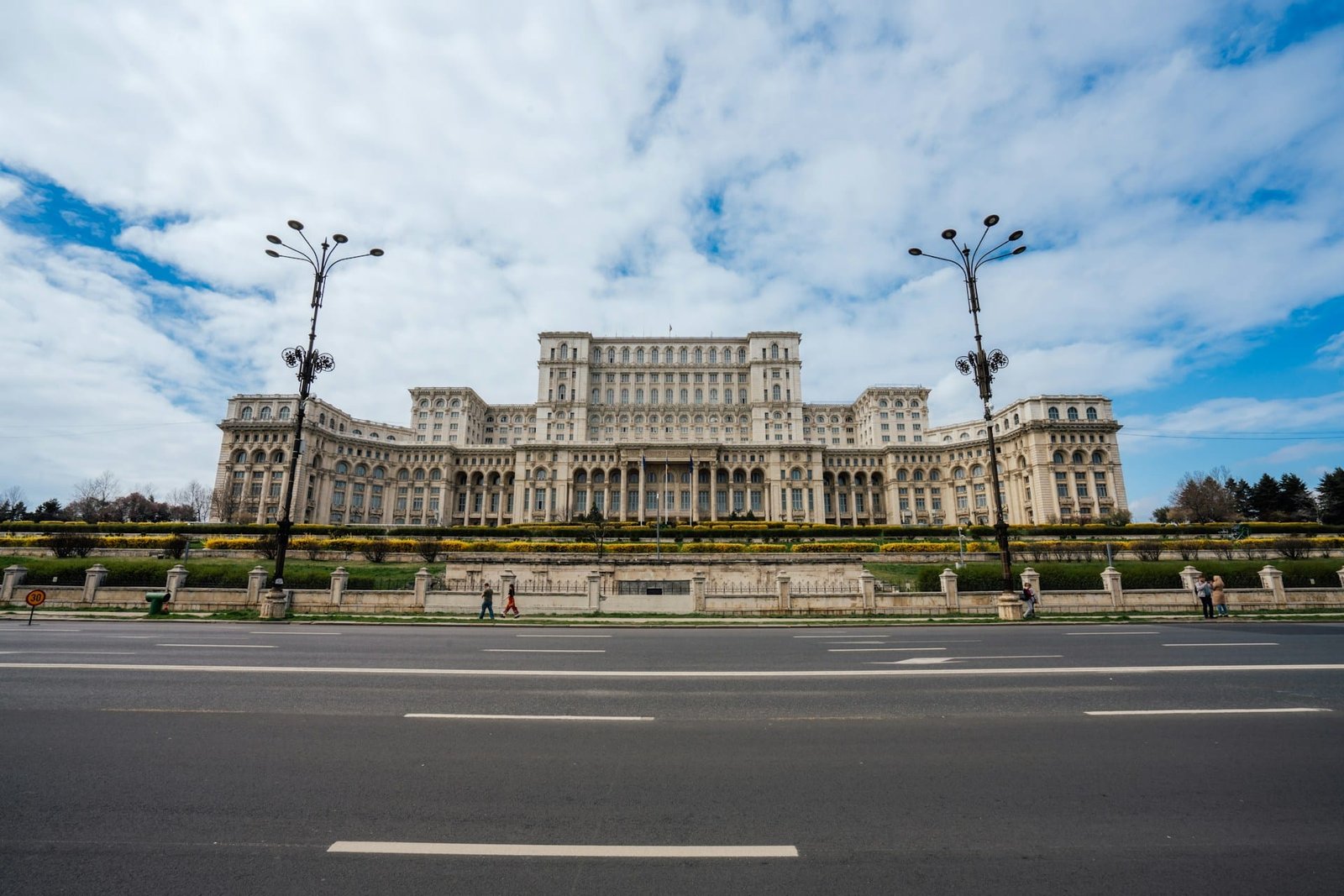
There was a delegation from Romania in the camp. Smiling, one of the girls shyly handed me a postcard. The card was thin, the colour faded, and the print quality blurry. On its front was a featureless building. I was staring at a photograph of a large, concrete building with an imposing front door, and flags at the entrance. The building looked intimidating and unbelievably sad.
I stroked the postcard with my thumb. Why was such a severe building worthy of a postcard? Why was it making me feel uneasy? What did it mean?
I looked up at my new friends from this unfamiliar land. I found them to be kind and at the same time more reserved, more earnest, and somehow less carefree than the other children. I was now seeing these qualities reflected in a postcard. Like an idea on the tip of my tongue, I had a flickering sense that not all children lived in societies as benevolent as my safe and happy world.
It was only a moment. I tucked away the postcard with my souvenirs and thought no more of it.
Some years ago, I visited the building. Well, it could have been the building; the anonymity was the point. I was in Bucharest with a colleague to secure approval from Ministry officials for a commercial deal. As I walked through the entrance with my kitten heels clacking away on the paving slabs, I discovered first-hand the meaning of the photograph. I saw not only the long, silent corridors, but the legacy of an authoritarian regime. As each official waved us along, the fear of accountability still weighed heavily.
I see the postcard when I close my eyes; the imprint is like a bright light that endures after looking too long out of a window on a sunny day. Only now, I wonder if this was when I first experienced a shift from seeing the world through my own childhood perception towards understanding that there was a broader perspective to explore.
I had thought that my decision as a teenager to study languages, a step towards a lifetime of travel, was inspired by an inability to master sciences. But now I know the turning point. When I look back on that summer, it is like replaying a cartoon that I once loved as a child, and now seeing the adult themes woven through the story. The eleven-year-old who used to walk to her nana’s house in the shadows of Byker Wall has travelled a long way.
Photo by Winston Tjia on Unsplash