
So, you’ve joined the altitude elite, flying private for speed, comfort, and, let’s be honest, sanity. But here’s the thing: the real luxury isn’t just the champagne or the leather recliners. It’s the ability to actually get work done while cruising at 40,000 feet.
And that, my friend, is where most private jet conversations go flat. Everyone talks about opulence. Almost nobody talks about output.
Let’s fix that.
The Shift: From “In the Air” to “In the Zone”
Once upon a time, private jets were designed for rest, not results. Think plush sofas, not power sockets. Fast-forward to 2025, and business travellers want more than silence, they want signal.
With companies like Chartright Air Group reimagining their fleets for hybrid-era executives, the focus has shifted:
- Less bling, more bandwidth.
- Less champagne flute, more charging port.
- Less lounge, more LinkedIn Live-ready.
When your client call follows you from Toronto’s tarmac to a descent over Vancouver, that’s not luxury, that’s leverage.
Step 1: The Cabin Layout That Means Business
Let’s start with space, because productivity at altitude starts with design, not Wi-Fi.
The smartest jet interiors (Chartright’s Challenger or Citation fleets, for instance) are built around zones:
- Work Mode: Rotating club seats around a central table — perfect for deal memos or that PowerPoint nobody finished on the ground.
- Privacy Pods: Some aircraft feature partitions or directional lighting to create call-ready corners. No more awkward “Can you hear me now?” moments.
- Rest Mode: Reclining seats that convert into flat beds, because recharging between meetings counts as productivity, too.
It’s the airborne equivalent of a co-working space with clouds.
Step 2: Connectivity That Keeps You in the Loop
Let’s be honest: no one cares how comfy your seat is if your email freezes mid-send.
Chartright’s modern jets are equipped with satcom systems and high-speed Wi-Fi, making Zoom calls and Teams sessions actually possible, not just promised.
A few in-flight essentials for the digital nomad CEO:
- Ka-band satellite internet: Delivers enough bandwidth for video conferences and large file transfers.
- Secure VPN capability: Critical for financial firms and executives sending confidential documents.
- Bluetooth and USB-C integration: Because nobody wants to dig for that 2007 charging cable at 39,000 feet.
Bottom line: your office Wi-Fi might buffer more than a Chartright connection. (True story.)
Step 3: Ergonomics, Lighting, and Human Factors
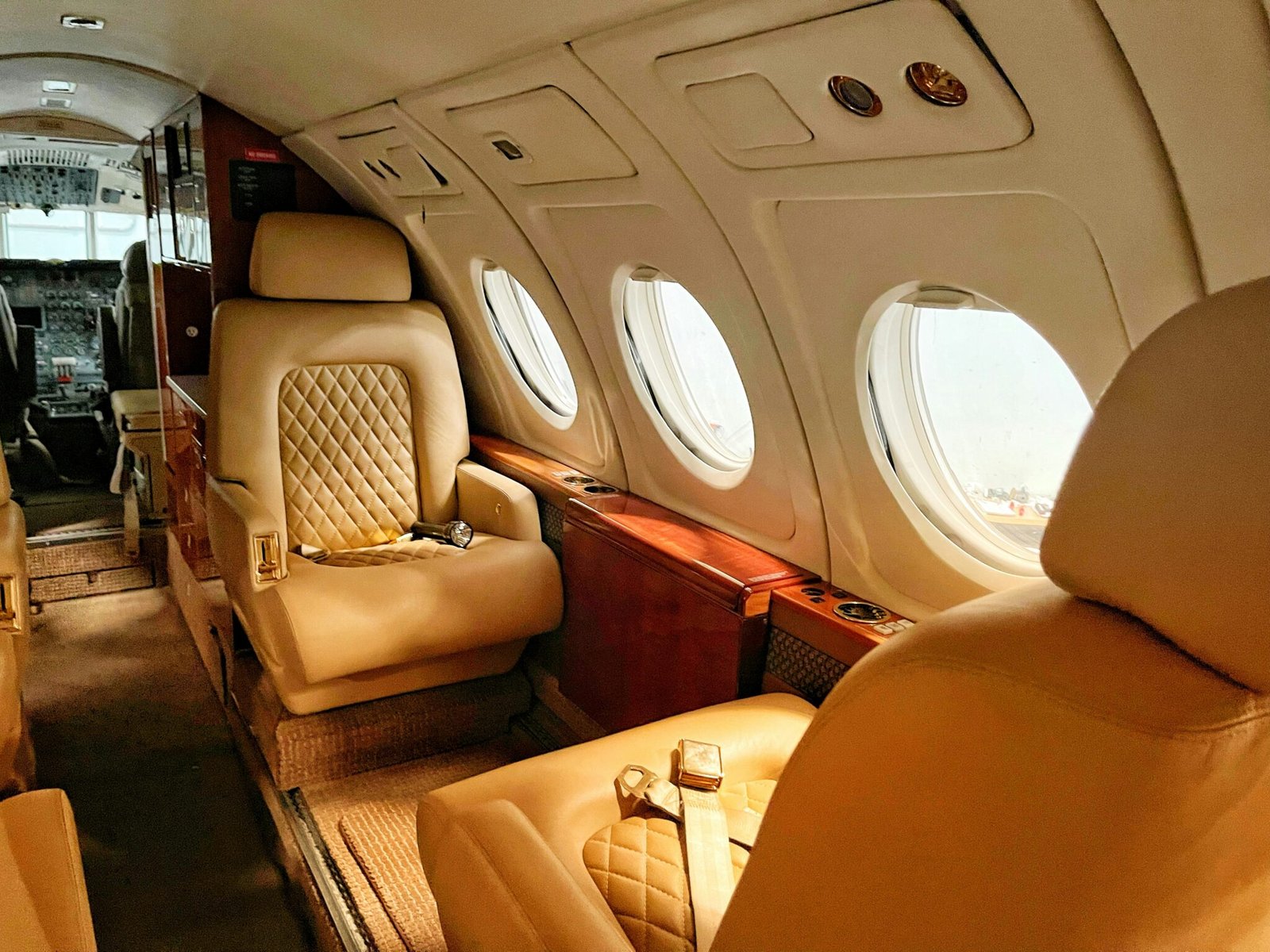
Let’s talk posture, not the LinkedIn kind. The physical one.
Private jet interiors today are subtly evolving from “luxury recliner” to ergonomic workstation. Adjustable armrests, lumbar support, and noise-reduced cabin acoustics are becoming the gold standard for long-haul business charters.
Even lighting plays a role:
- Warm tones for deep work.
- Cool daylight for alertness during morning flights.
- Dimmable panels for eye-friendly evening landings.
A few Chartright aircraft even allow lighting presets — meaning you can literally set “Work Mode” or “Rest Mode” like an app.
Productivity never looked so ambient.
Step 4: Privacy and Call Spaces at 40,000 Feet
Here’s something rarely discussed outside pilot circles: sound travels differently in pressurized cabins.
That means your negotiation call with a client in Calgary doesn’t need to be shared with your co-founder in seat 3A.
To solve this, many private jets now feature:
- Acoustic partitioning and insulation zones.
- Directional microphones for clear voice pickup.
- Smart headsets with noise-cancelling adaptive tech.
Chartright’s cabin configurations for mid- and large-size jets often include semi-private areas – effectively mini “meeting pods” in the sky. It’s privacy with a view.
Step 5: The Balance Between Work and Recovery
Let’s face it, not every flight needs to be a productivity marathon.
Business travel fatigue is real, and the best-performing executives know when to power down. That’s why sleeping vs. working modes are now integral to cabin design.
Convertible seating, ambient sound masking, and circadian lighting help passengers rest efficiently between meetings. The result? You land sharper, not sleep-deprived.
It’s not indulgence. It’s operational readiness.
Step 6: Hybrid Work Culture Meets High Altitude
Here’s where the future gets exciting.
In 2025, “office hours” don’t end at 5 PM, and “office space” doesn’t need an address. Executives are running full remote briefings mid-flight. Private aviation isn’t just for C-suite comfort; it’s for hybrid continuity.
Imagine this scenario:
- The CEO flies from Toronto → Calgary for an investor meeting.
- CFO joins mid-air via Chartright Wi-Fi.
- Marketing director dials in from Montreal.
Same deck, three time zones, zero turbulence (at least in connectivity). That’s the future of executive collaboration.
Step 7: The Next Evolution, AI, Smart Cabins, and Predictive Comfort
We’re moving toward AI-driven cabin environments, where lighting, temperature, and noise levels auto-adjust based on your biorhythms or workload.
Chartright’s next-gen jets may integrate predictive comfort systems that sense movement and adjust posture support or lighting before you even reach for a switch.
Think “JetGPT,” but for your seat.
Final Descent: Productivity Is the New Luxury
Forget the cliché of “work hard, play hard.” The modern executive does both, simultaneously, at altitude.
With the right jet, you can brainstorm product strategy somewhere over the Rockies, close a deal mid-Atlantic, and still nap before landing.
That’s not travel, that’s tactical time management.
And with Chartright’s fleet leading the way in cabin design, connectivity, and comfort, the line between luxury and productivity isn’t just blurred, it’s beautifully airborne.
Image: Raymond Kagie, Unsplash